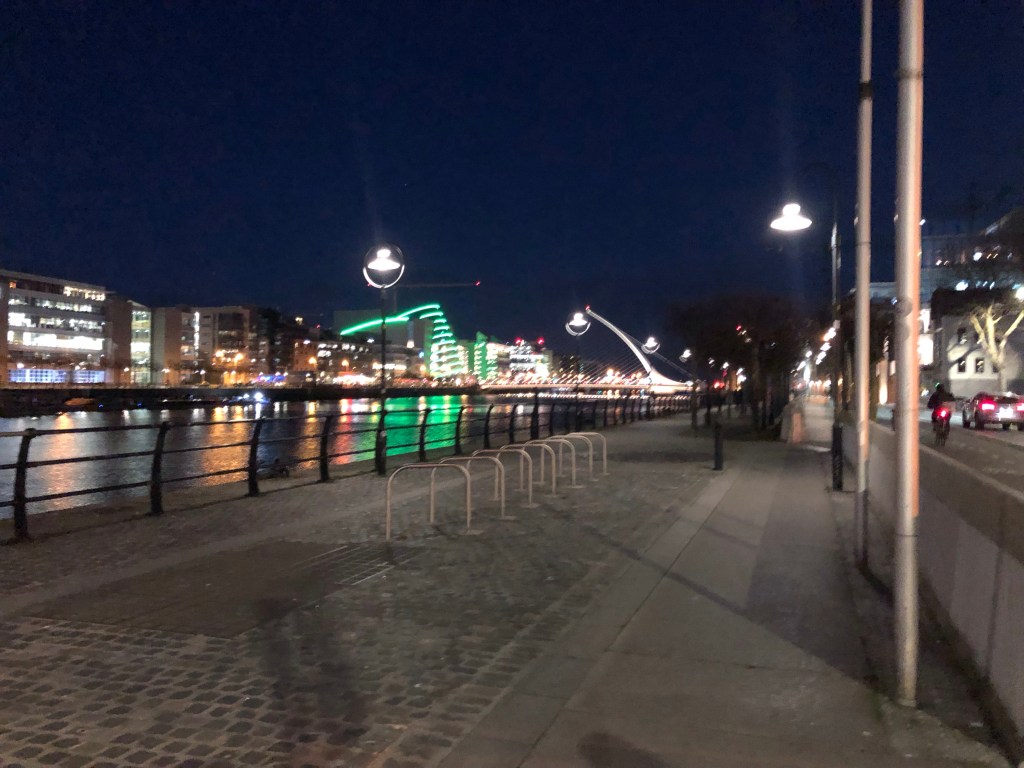
Back at the end of March, I went to Dublin with Amy-Louise Smith and Katherine Butler to present a panel at the Renaissance Society of America Annual Meeting in Dublin. It was a really lovely few days, and good to be back at a face to face conference, and this is the first in a pair of posts about the trip.
We flew out on Wednesday morning, and gave our panel in the afternoon just after we arrived. We were speaking on Soundscapes of Popular Song in Early Modern England. We started with Katherine’s paper on ‘Melodious humonically musiquALE’: Catch-Singing and the Soundscapes of Good Fellowship, 1550-1650, and presented her findings so far on the ways in which early modern people sang popular harmony songs. My paper was based on some of my research into the Pilgrimage of Grace and why Thomas Cromwell was so interested in the ballads that circulated around that time. Then my PhD student, Amy-Louise, talked on some of her research in a paper entitled Solidarity or Conflict? Singing Libellous Songs in Early Modern Communities. The panel went really well and was very well received – we got some lovely comments and really interesting questions, and the audience seemed very interested in our work. Katherine and I are working on a grant application based on our papers, but it’s got a way to go yet!
The following morning we went to listen to the panel on Renaissance Music: Performativity and Failure. Jennifer Linhart Wood and Sarah Williams both talked about the role of bad singing in early modern theatre.
After that, I went to Bewley’s cafe for a late breakfast with Amy, which was excellent. Amy then went home, and I went to hear a panel on Manuscript Circulation and Dissemination in Early Stuart Britain: Agency, Networks, Genre. Alex Gajda talked about the Autobiographical ‘Apology’ as Political Intervention in Manuscript and Print, describing the ways in which autobiographical allows the speaker to give a defence of seditious acts, allowing them to present themselves as loyal to the crown. On the other hand, it removes plausible deniability. She argued that the apologia is a genre that is a defence against slander.

Chris Kyle then presented on Central Authority and Local Agency: The Recirculation of Proclamations in Early Modern England. He noted that there is little to explain how proclamation texts were used once they were received. He identified three distribution networks: the centre; nodes; and communal-local networks. The central network is linked to nodes and we have some survivals of lists for distribution. From there, proclamations seem to have been circulated to father from the town nodal points. Kyle looked at the distribution of the proclamation of the death of Elizabeth I and accession of James I. He showed that not all of them were the printed version and it seems that extra manuscript copies were made to ensure circulationt beyond that of print. It would appear that circulation could be very swift. Local networks were able to pass them on over a matter of days. Communal circulation spread far beyond the central distribution networks and market town nodes. Local elites employed servants to pass copies between elite houses and ensure they were heard local communities, so we need to consider scribal circulation and then dissemination into local communities alongside the oral proclamations and the posting up of printed copies.
Finally, Laura Stewart gave a paper on ‘Public Informations’ and ‘Private Passages’: Manuscripts within a Manuscript. This talk focussed on manuscript circulation and the mobilizaton of opinion in early modern Scotland, featuring her work on squibs and pasquils that undermine Scottish bishops through the laughter of the commons. She pointed out that laughter of the lower orders is often seen as seditious – undermining jests were often accompanied by threats. In this period the word jest is often associated with darker, meanings such as scoffing, and it was though that it would not be long before the laughter stopped and the shooting started.

On the Friday morning, I was really pleased to be able to meet properly the organisers of last year’s The Experience of Loneliness in the Sixteenth and Seventeenth Centuries conference, Hannah Yip and Thomas Clifton. I gave one of the keynotes at their conference, and I still hope to be able to be able to upload the video of it to YouTube soon. Hannah’s was the first paper in the panel on Marriage, Loneliness and the Desire for Solitude in Early Modern Britain; It is not good that the man should be alone: Genesis 2:18 in Post-Reformation England. She pointed out that companionship was recognised as important as it was God-given in Genesis. Importantly, laments were preceded by the vocative ‘O’, which allows us to empathise with the speaker. She also explained how the careers of clergymen, as well as their personal lives, influenced their sermons.
Amelia Worsley then spoke on A Sad Spirit Wedded to Loneliness: Milton’s Divorce Tracts. She noted that loneliness is a new term in the 17th century although usually it is associated with the 19th century rise of individualism and thought to have been an invention of the romantic poets who separated it from solitude. But it appears in the 17th century as a term, especially in Milton. He didn’t invent the term and wasn’t the first to use it, but he is the person who uses the term most. She suggested that according to Milton, it can occur and even be exacerbated by the marriage of unsuited individuals. His divorce tract argues that married people should not be forced to stay together of the partnership causes loneliness – for example, if creating sociable delight is impossible, why should they be forced to procreate? He argues that marriage that’s unhappy is like being a “sad spirit wedded to loneliness.
Finally, Thomas Clifton gave a paper on Marriage, Morality and Isolation in the Meditations of Lady Elizabeth Delaval in which he noted that Delaval doesn’t use the expression loneliness, so we have to unpick her referencess to it. Her writing invites questions about what it meant to be feminine and about females desire. Nevertheless, she doesn’t write much about her husband and they don’t come over well as a couple – in fact, she compartmentalises her experiences of men’s desire (she received several marriage proposal). She reviews, reshapes and rewrites her meditations, which were written for a female audience. She became a Jacobite exile when she married for a second time and she was downgraded to “Mrs”, and it was at this point of her life that she transcribed and edited her manuscripts, making them the product of exile and possibly isolation.
After the panel, I met up with Tracey Hill for lunch. It’s almost two years since my husband and I recorded a song from the 1620 Lord Mayor’s Show for Tracey, but like Thomas and Hannah, we’d never actually met until Dublin! So it was great to be able to use the time to meet up with people too!
 Home
Home 
Leave a comment