There have been several things keeping me busy over the last few months. One of the biggest was the live performance of John Balshaw’s Jigge that we gave in Brindle on 17 June. It was a fabulous experience for all concerned.
Last autumn I engaged a director I know who lives in the Isle of Man, Chris Maybury, and two of the musicians from Passamezzo, Tamsin Lewis and Robin Jeffrey, agreed to provide the accompaniment on period instruments. Then just before Easter, I auditioned cast members from Lancaster University, having contacted the Music Society, Folk Society, Re-enactment Society, LU Sing and the Theatre Group, as well as offering the chance to students in English and Creative Writing, History, and the Lancaster Institute for Contemporary Arts. I found a small group of students who were really enthusiastic about the project, and they were supplemented by a professional actor with experience of performing Tudor jigges, Richard de Winter. I sent them all scripts and recordings of each scene so that they could learn their parts before the rehearsals began. It was then a case of waiting with fingers crossed until the first rehearsal!
While I waited, I started to think about the other things that needed doing. We borrowed most of the costumes from Professor Alison Findlay in English and Creative Writing at Lancaster. She puts on a Shakespeare play with her students each year as part of one of her modules, so there were plenty of costumes to choose from and we managed to get most of what we needed from her wardrobe.
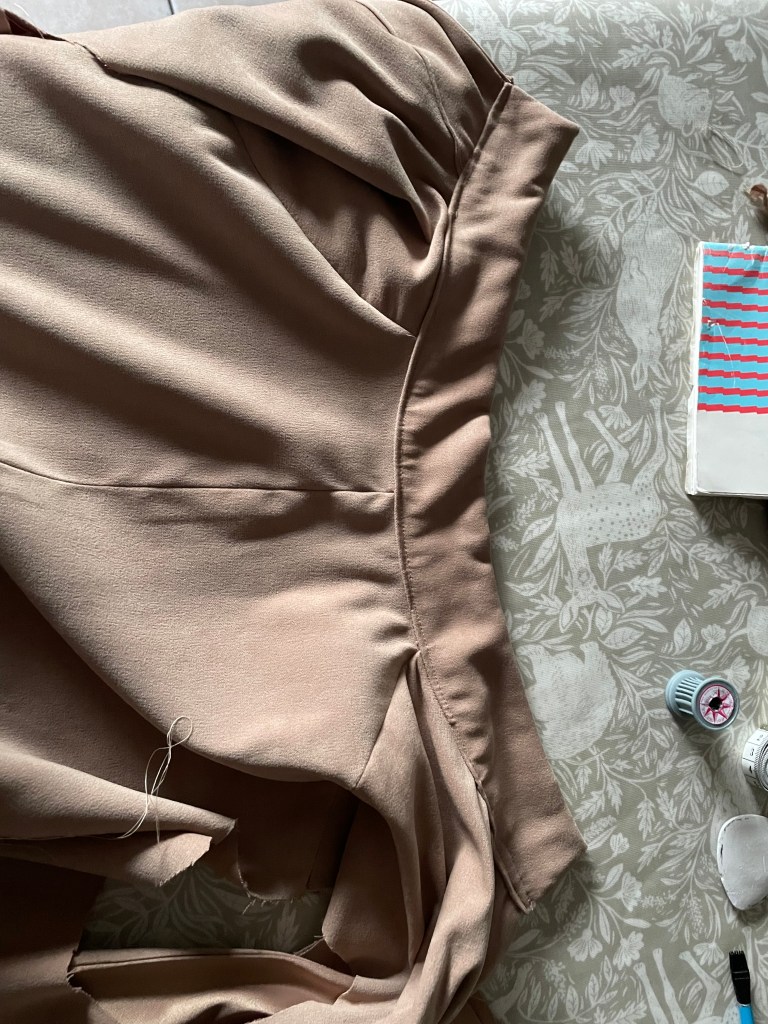
But there were a few bits and pieces that I had to put together myself. For example, the script demands that Bobbe, the servant, be given a coat of ‘good canvas’ decorated with ‘guards of blue, yellow and grey’. That wasn’t going to be something I could just find from existing supplies – I had to make it. It took me a while, but I did get it done, and I’m very proud of it because it is the first thing I’ve ever sewn following a pattern. I also made Bobbe a hat to go with his coat, and I made a pouch that could be attached to a character’s belt in order to carry the props that were needed.
There were a few other things I had to buy to add to the costumes. I got hats and added feathers to them, and even found myself ironing flat the brim of one to make it fit the period better! I bought two cheap academic gowns and trimmed them with fur and velvet. I also had to pick up a couple of pairs of shoes for cast members, and various bits of jewellery and gloves.
Another thing that needed organising was the set. This was quite difficult, as it needed to be easily transportable in or on a normal family car! I drafted in my daughter to be in charge of set design and stage management, and my husband to help with the practicalities. The script demands that the set includes a seat, so we found an old toy chest that we’d had since the children were little. We decided that we would use this to support some pieces of trellis that could be covered with a duvet cover that we picked up in a local charity shop. Another layer of the set was created with some green fabric for the outdoor scene at the beginning of the jigge. We turned the chest into a seat by covering it with an old curtain, and we I made matching cushion covers for a pair of second hand cushions that I bought in. After the first rehearsals we had a production meeting with the director, and we decided on a few finishing touches which included a couple of plants to signify the outdoor scene at the beginning.
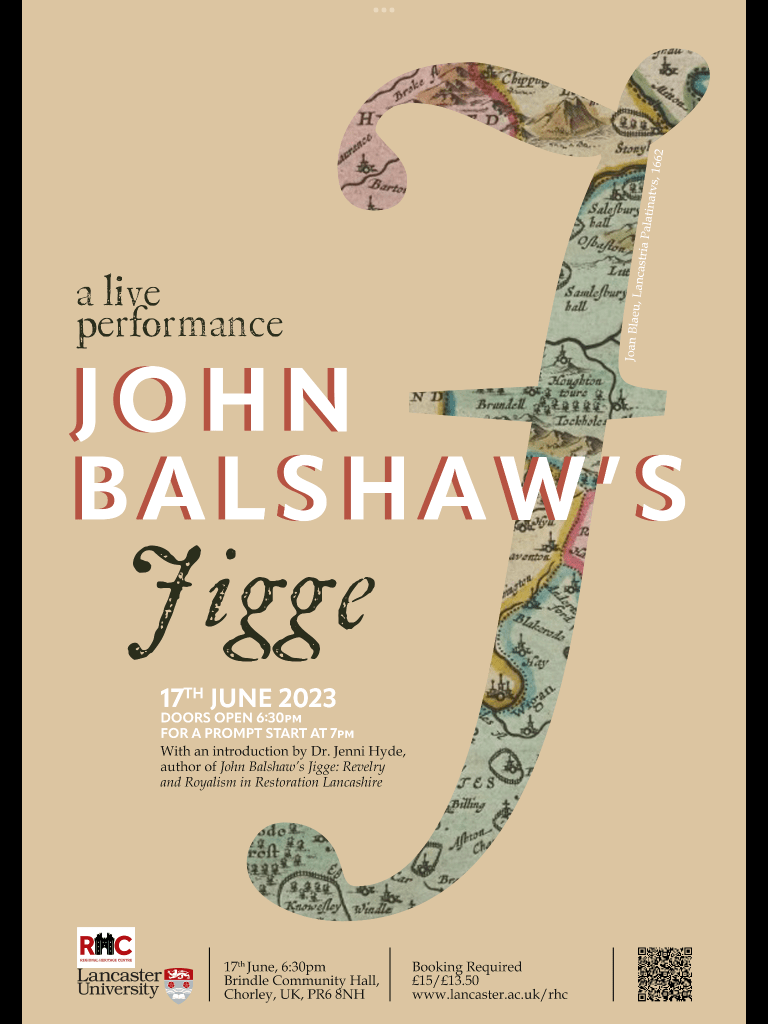
Of course, every performance needs good publicity. I asked my very talented PhD student, Amy-Louise Smith, to design the programme and poster, and she did us proud – they were fantastic. I also did an interview for BBC Radio Lancashire, had a feature in the Lancashire Post, and wrote a blog post for the Civil War Petitions website.
Finally, I created an ‘academic’ poster for display at the event, which included information about what a jigge is, who John Balshaw was and why the piece is important, and I wrote my short introductory talk about the jigge and the civil wars. All that was left to do was to wait for the director to arrive at the beginning of June to get the rehearsals underway…
 Home
Home 
Leave a comment