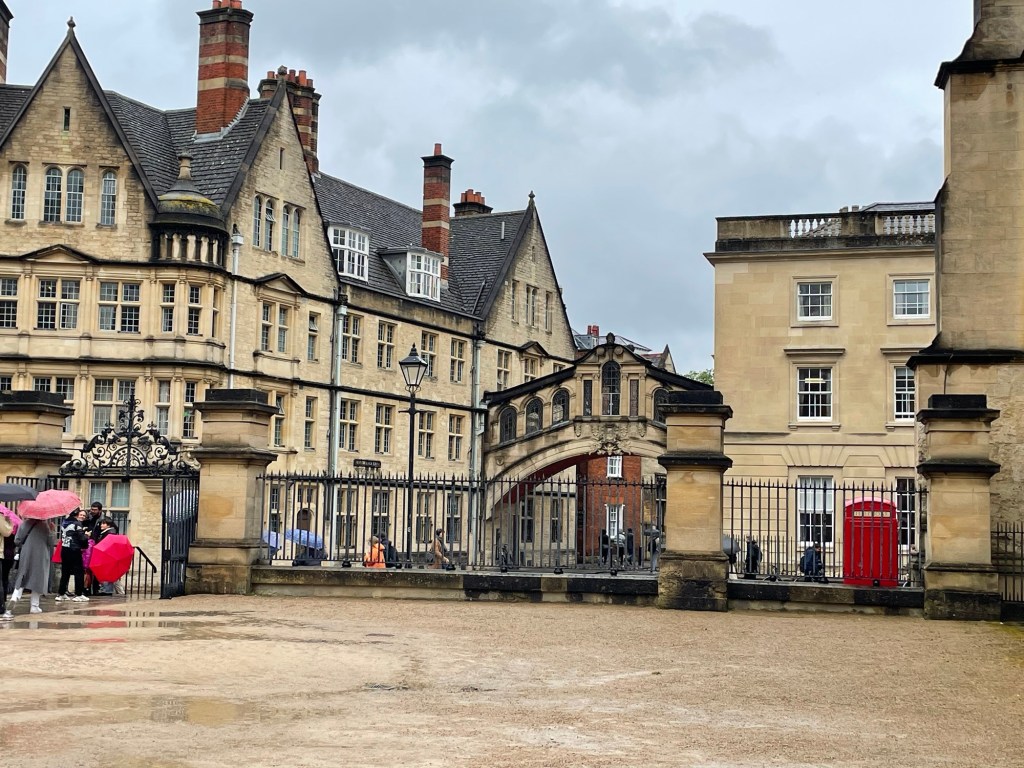
This week I escaped the university. I did my teaching on Monday, of course – a two hour workshop on sources related to Luther’s Reformation, as well as an extra lecture on preparing for the exams aimed at our third years, who are taking their first in person Lancaster exams this year. Then on Tuesday it was off to Oxford on the train, for a few days in the Bodleian Library, some research seminars and a chance to catch up with my fiend.
It’s been a tough few weeks, as I was told in mid-April that my two day fixed term contract will not be renewed in August as pretty much everyone in the department had anticipated that it would be. I’ll still have the two permanent days, but they aren’t going to pay me enough to keep us going so that might sound the death knell of my academic career and my research plans.
It’s been quite a tough year, what with the heavy teaching load before Christmas.
So it was very nice to spend a few days reminding myself why I do this. I can’t actually remember the last time I spent several days in an archive. There have been a few smash and grab jobs (not literally, of course – just very short trips where I took lots of photos in a few hours), but I probably haven’t had a sustained period in an archive where I could actually sit and read documents, look things up and make a start on transcribing them for years. Like, since I did my PhD. I guess a lot of my colleagues wouldn’t think two and a half days was very much, but compared to two and a half hours, which is much more my norm, it was incredibly relaxed.
So, I managed to get to grips with a couple of manuscripts that I think will prove really useful for my Pilgrimage of Grace research – on which there will be a bit more musing soon, albeit related to how I might go about things rather than any progress that has been made. And it was particularly nice to have the time to sit and think about them. I thought I had probably peaked on Wednesday morning, when I found a letter which I was able to sit and transcribe and there was a single line in that I thought I might be able to use in passing in my book. Then yesterday morning I found something really, really good. I need to go back and check against some other sources, but in any event, it’s really added something significant to my source base.
But I made another interesting discovery. Bear with me, as the point might take me a little while to get to. Palaeography can be hard. It can be interesting, but it can be hard. I’ve never thought I was particularly good at it, but I think I had a phase of just looking at some really poor quality images of some really tough material. The images I got last autumn from the National Archives were considerably easier, but even there it’s still a slow process. Having found my really interesting document yesterday morning, I excitedly told my fiend when we met for lunch. I showed him the image, and over a pasty from the covered market eaten in a college quad, we raced through a reading between us. Not perfect (and I didn’t take notes), but quick, and certainly good enough to get a good sense of the content.
So the other discovery was that palaeography is much more fun when you do it with other people. Historians, by and large, are solitary creatures, in the sense that many of us do most of our research alone. I hate feeling like I’m being watched while I work. It’s probably an imposter syndrome thing, and I do know for certain that it is in my head – no-one is actually watching me because they have more important things of their own to do. But it doesn’t stop me feeling that way. But lo and behold, I found puzzling out the sixteenth century handwriting much more fun in company. Maybe it was because there was some excitement over what it was I’d found, but it was a revelation in more ways than one.
 Home
Home 
Leave a comment