This is the third in a series of short posts about the Sound Faith: Religion and the Acoustic World 1400-1800 conference at the University of York from 12-14 June 2024.
There was then a tea, coffee & cake break before the second keynote: Felipe Ledesma-Nuñez (Harvard)’s ‘Coya Huarmi: Reconstruction of a Song, a Vessel, and an Ancestor’s Voice’. As this was about the pre-Columbian Americas, this really appealed to me because I did my undergraduate dissertation on the transmission of culture in Aztec Mexico and the impact of the Spanish conquest. Felipe began by demonstrating his coya huarmi, a ceramic jar which makes noises when filled with water that is based on a description from an early modern source of an indigenous artefact used in the dancing and singing that went with the new thatching of a house. This was followed by a paper that explained the various strands of different disciplines that had allowed him to recreate the jar and the music it created through the use of
- linguistics, music analysis, and palaeography
- anthropology, society and silence
- archaeology, ceramics and ritual
In the first section, he described the witness accounts from an investigation into indigenous cultural activity by the Jesuits. These talked about the coya huarmi, which are unreliable but they give some idea of what the words might have been, as some appear more than one account. Using linguistics he looked at the line lengths, rhyme schemes and the pronunciation gives a sense of the metre through the accent balance. This gives a sense of what it sounded like even if not the melody. Looking at the subject of the words, it shows that the subjects change with the rhymes, so this suggests melodic phrases. The inclusion of a single line in all the witness accounts suggests it stood out in some way, perhaps as a refrain. He pointed out that motif, phrase and refrain are originally words from linguistics, not music.
Next he described using anthropological techniques to investigate what sort of woman the coya huarmi was, and the cultural relevance of the rest of the words and the significance of cultural figures and concepts. The evangelist investigation caused the indigenous population to hide cultural material and create silences.
There was clearly a close association between water and coya huarmi. The vessel was, Felipe thinks, a water activated whistling bottle. The ceramicists had to have a good practical understanding of physics to make the whistling bottle work (in fact, Felipe claimed they had to be highly skilled to do so), but there has been no evidence for how they were played until Felipe identified the item in the witness statements as a whistling bottle. He closed by positing that the sound was not a reproduction of the voice of the woman, but that of the ancestor herself – giving voice to the sound gave the ancestor life.
After the keynote we walked into York to the National Centre for Early Music, for the first UK performance of the anonymous work San Francisco Xavier: An Indigenous Baroque Opera by the early music ensemble El Parnaso Hyspano written in the Chiquitano language in the early 18th century. It is the first known opera to be written in an indigenous language.
The concert performance included a panel discussion by Rafael Montero (Founder, El Parnaso Hyspano), Michael Walling (Artistic Director, Border Crossings & Visiting Professor, Rose Bruford College), and Lauren Working (Lecturer in Early Modern Studies, University of York). It was chaired by David Stirrup (Director of the Centre for Indigenous and Settler Colonial Studies, University of York) and considered some of the issues around authenticity and respect for Indigenous traditions and culture when approaching such music in a contemporary Western context.
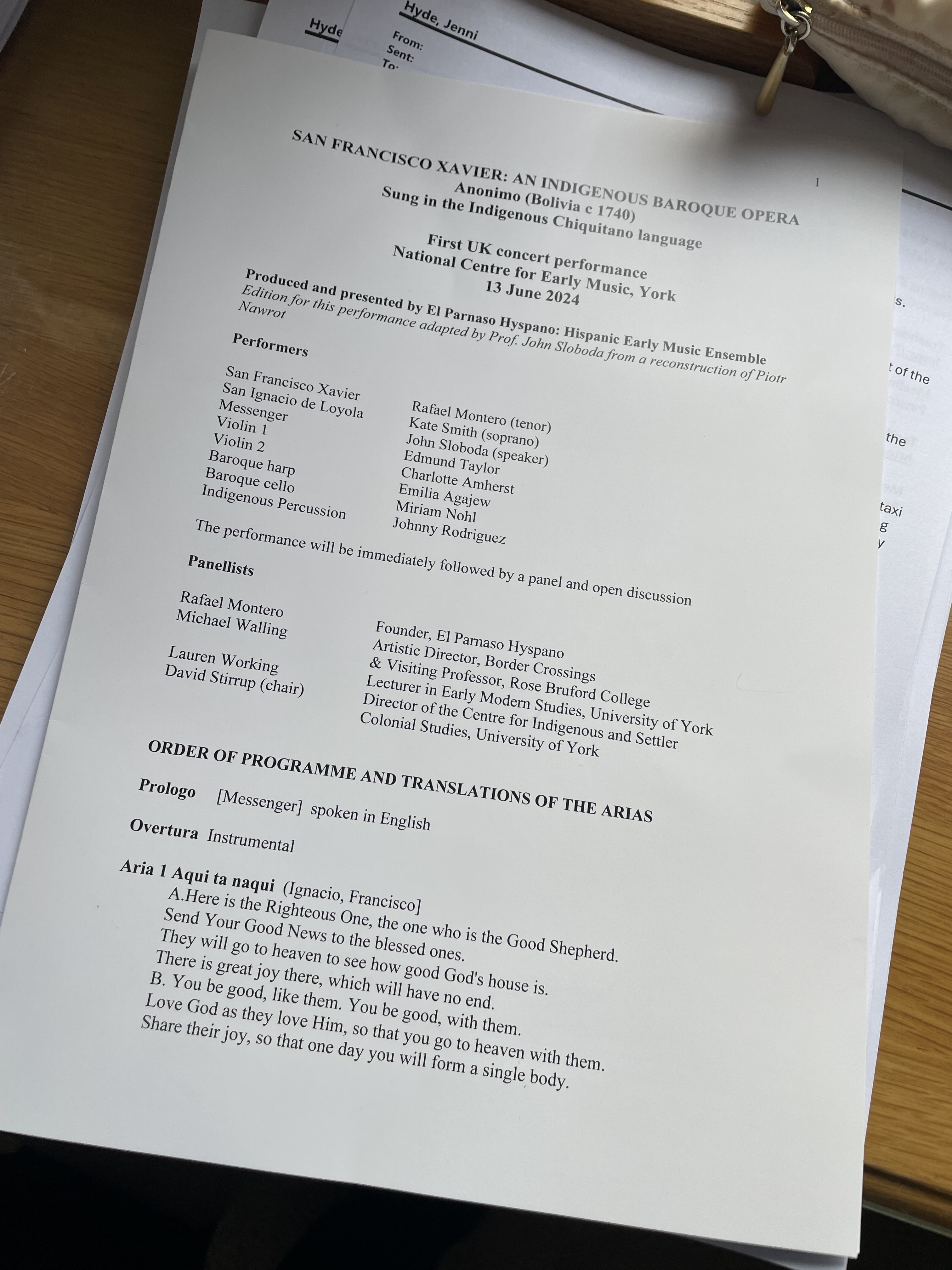
The performers were
- San Francisco Xavier – Rafael Montero (tenor)
- San Ignacio de Loyola – Kate Smith (soprano)
- Messenger – John Sloboda (speaker)
- Violin 1 – Edmund Taylor
- Violin 2 – Charlotte Amherst
- Baroque harp – Emilia Agajew
- Baroque cello – Miriam Nohl
- Indigenous Percussion – Johnny Rodriguez
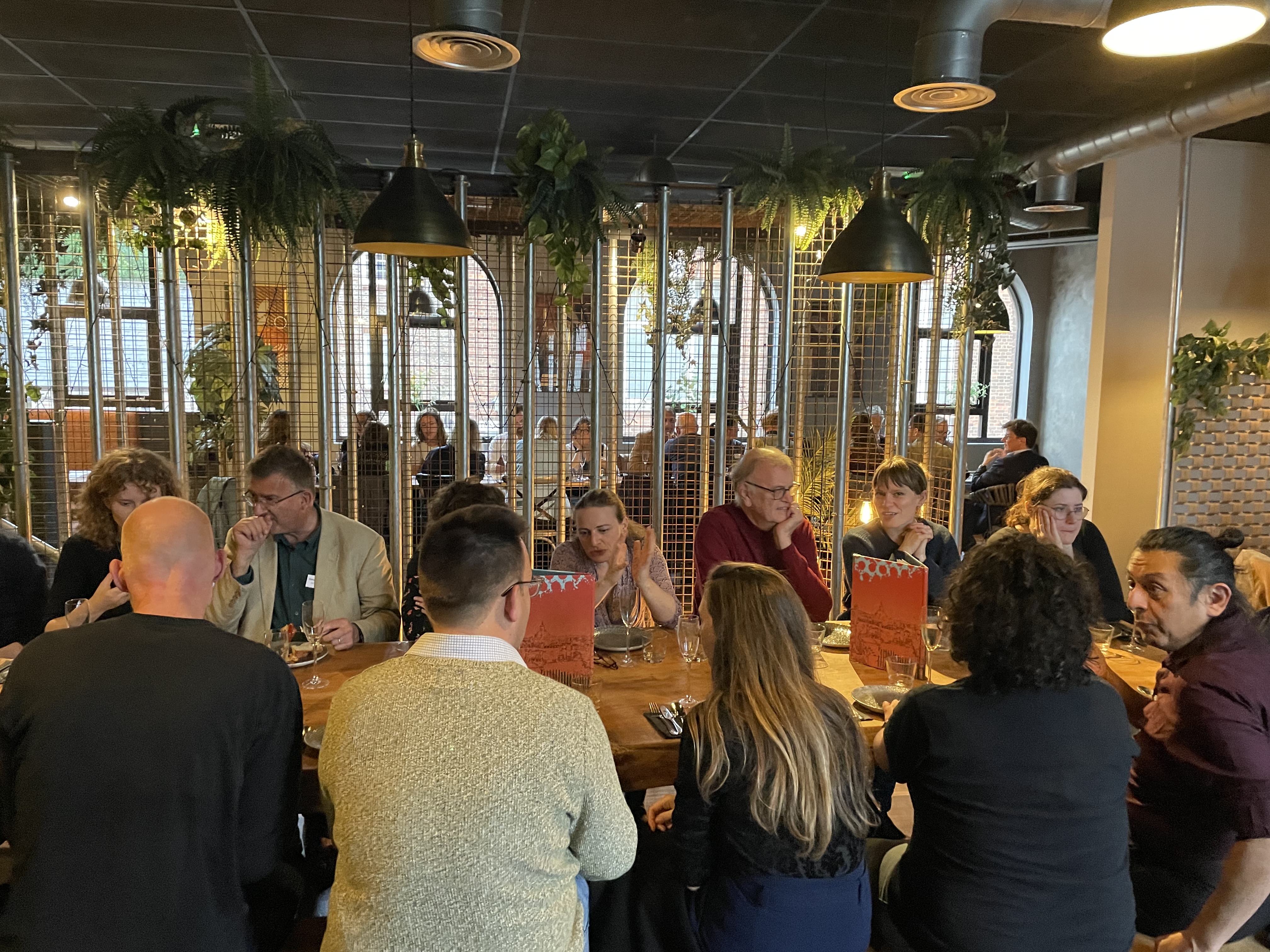
After the concert we went for a lovely vegetarian dinner at AMBIENTE, FOSSGATE. They brought lots of small dishes to share, and it was a very relaxed meal – desert was served at ten to ten!
 Home
Home 
Leave a comment