This is the first of a short series of posts about my trip to Utrecht, to the EDPOP conference.


I’d given myself plenty of time to get to Utrecht, as I wanted to be able to have a good look round while I was there, as well as allowing for travel delays. As it was, everything ran very smoothly and I was able to visit the Museum Speelklok before it closed, the day before the conference began. It is full of mechanical musical instruments. Those of you who have been reading this blog for a long time might remember that I am very fond of the Mechanical Music Museum in Northleach. I first went there in my teens on a family holiday; the last time I visited was on my research trip to Oxford. Discovering that there was a similar museum in Utrecht meant that it jumped to the top of my list of things to do!
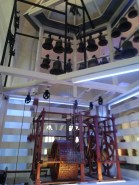 Housed in a disused church, it was appropriate that the first stop on the guided tour was a 15th century carillon, which still works. Carillons like this one played tunes in order to get the attention of the townspeople, before they chimed the hour. The idea was that people who heard the tune would know that the hour was about to strike, so that they could listen out to see what time it was – without the tunes, people might well miss the time. The tunes on these carillons could be reset, but it was done infrequently not only because it was a difficult and time consuming operation, but also because the carillon would be out of action during the process, leaving the people without their chimes.


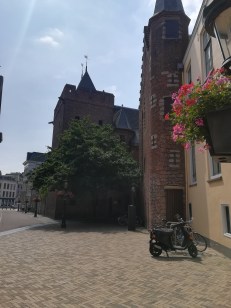 The conference itself was held at the Faculty Club, a former 15th century canon’s house. It opened on the afternoon of Thursday 8th June with a short welcome from Frank Kessle, Director Institute for Cultural Inquiry (ICON) at the University of Utrecht. EDPOP Project leader Jeroen Salman (also from Utrecht) gave an update on ‘EDPOP in progress’, at which he launched the EDPOP Virtual Research Environment which will bring together collections and catalogues, making them accessible via one portal. The project will continue until the end of 2018; it has brought together a network of 50 scholars who have held 9 workshops and 2 conferences, and it has produced an edited collection. Further outputs will include a publication of the proceedings of the 2018 conference, as well as a taxonomy and glossary of popular print culture.
- print is a medium – it has no intrinsic spatiotemporal characteristics and its availability is contingent.
- the terms ‘early modern’ and ‘popular’ have overlapping conotations, especially with relation to being diffuse and non-bourgeois.
- whether pring culture is ‘early modern’.
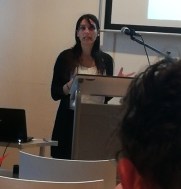 The introductory session, ‘Reflections on the life cycle of European popular print’, was then chaired by Malcolm Walsby. The first paper, entitled ‘The production of European popular print’, was given by Laura Carnelos. She identified a low cost of production as being the only consistent factor in European popular print. Jeroen Salman described ‘The distribution and dissemination of popular print in Europe’, pointing out that although popular print itself might be marginal and ephemeral, it was an economically important part of the print trade. He noted that it was associated with other, non-commercial cultural aspects such as singing and performing, and that the culture of popular print was also affected by regulation. Jeroen hoped that there would be an investigation into the ways that the dissemination of popular print was affected by different genres, regulations and disseminators. The next paper, ‘Consumers of popular print through Early Modern Europe’ was given by Shanti Graheli, who argued that use is the single most important factor in the destruction of texts. Popular texts were used extensively, but that use declined over time. Issues of survival make it difficult to reconstruct the activities of reader from the past, but indirect evidence is important. She concluded that form guided consumption, so we should explore it in conjunction with production and disctribution. Malcolm’s summing up raised questions about whether some aspects of survival relate to whether or not a house had somewhere suitable in which to keep its cheap print, as well as the matter of use.
 Home
Home 
Leave a reply to RSA Dublin 2022 Part 2 | Jenni Hyde Cancel reply