This is the first in a series of posts about the Virtual Medieval and Renaissance Music conference, which should have been held in Edinburgh. For me, this was one of the unexpected boons of the Covid-19 pandemic – I wouldn’t have been able to attend in person, but I was really glad of the opportunity to take part online.
The conference’s introductory video opened with a view of James Cook’s floating head in front of some visuals to give a flavour of where the conference would have taken place if it had been in person. Other organisers talked about the practicalities of the virtual conference too. MedRen had been organised with a mix of synchronous and asynchronous sessions to allow people from all over the world to take apart and to accommodate those people who have caring responsibilities during the day. All papers were pre-recorded and for many panels there were scheduled live question and answer sessions. But as an alternative, you were able to post a question in the chat box at any point during the conference. Several live ‘watch parties’ were also scheduled to allow those who were able to watch the concerts and keynote alongside others.
As I never know quite when things are going to crop up and get in the way at the moment, I headed straight for the sessions that were most relevant to me – so I started with the first panel on early modern English music, overlooking for a moment that Ross Duffin’s paper on ‘The Gude and Godlie Ballatis Noted / Tunes and Contrafacts in Early Modern Britain’ was about Scottish song! The strongly Protestant Compendeous Buke of Godlye Psalmes and Spirituall sangis, also known simply as the Gude and Godlie Ballatis, was first published in Edinburgh in 1565 and reprinted for decades afterwards. It contains psalms and ballads, and although it doesn’t contain printed music, there are tune directions scattered throughout the volume. I’m fascinated by the fact that the songs, meant for singing, haven’t really been analysed as ‘songs’ up to now. Ross gave an excellent account of the methodology that both he and I (independently, I might add) have come to for suggesting melodies for songs that have no tune indication. Although few tune directions were given in the book, this fact in itself suggests that they were obvious to the audience. His presentation then went on to reconstruct some of the songs, using tunes from, for example, Coverdale’s Goostly Psalmes of 1535, and particularly the Forme of Prayers (the Scottish Psalter) of 1564. There were also lots of lovely, sung, musical examples. What was really interesting, and is emerging more and more in early modern ballad scholarship, is the way that tunes circulate across Europe… (Una McIlvenna and Clara Strijbosch, I’m looking at you!). I was also fascinated to hear Ross suggest that the song set to ‘Balulalow’ in the Gude and Godlie ballatis might be the original, and as such the lost tune could therefore be the 1539 setting of ‘Von Himmel Hoch’.
Next, I listened to “Singing Jane Shore: Music and Propaganda in Richard Legge’s Richardus Tertius”by Joseph M. Ortiz. He argued that Hymen’s performance at the end of As You Like it functions not only as a dramatic performance of a textual form of instruction, but as a theatrical didactic performance – that is, a dramatic enactment of a dramatic enactment. Unlike settings of religious texts or vernacular poetry, songs in university drama are laden with classical imitations, so they were a pedagogical tools for humanists learning which translate classical texts into auditory forms. Each of the three plays which constitute Richard Legge’s Richardus Tertius ends with a song, and they bear no resemblance to the Senecan models. They aren’t commentary, or allowing time for costume changes. Taking the example of the song about Jane Shore from the end of the first play, he argued that the meaning of the song contrasts with the sentiments of the characters who sing it. It is a formal event, rehearsing a conventional morality in the performance of its propaganda. Turning to the songs in Thomas Heywood’s Rape of Lucrece, he suggested that this might explain why the bawdy songs seem so at odds with the tragedy of the play. Heywood capitalised on his classical training by using it to write the play, but recognised that the performance of song allowed the expression of scepticism about that learning.
From there, I jumped to Day 3, with Music in Early Modern England II. The first paper was fascinating, and something I’ve been interested in for quite a while although I’ve not done much work on it: Katherine Butler talked about ‘Rounds and Catches in Sixteenth-Century Society’. They have received little scholarly attention, and although they are often associated with drinking culture, they are a very varied genre. She gave a preliminary round up of sources and offered some thoughts on by whom and where they were being sung. The singing of a catch in Shakespeare’s Twelfth Night fits the stereotype of these songs being sung by commoners, often in alehouses when drunk. However, by placing it in the context of other evidence, she showed that the reality was that the social positions of catch performers were far wider than just tradespeople, nor were they exclusively associated with drinking. She talked at some length about Thomas Ravenscroft’s Pammelia, as well as some lesser known examples, suggesting that there was a common repertory in the early 17th century. She argued that some of the rounds and catches were aimed at royal events, or were complex rhythmically or with 8, 9 10 or even 11 voices. Some were on religious themes, and although its not clear whether the rounds and catches were ever sung in the context of church services, it seems that some were associated with bellringers. She speculated that, as several rounds and catches begin by singing through the hexachord, that they may have been used in the training of choristers. Overall, she commented on their ubiquity in early modern England.
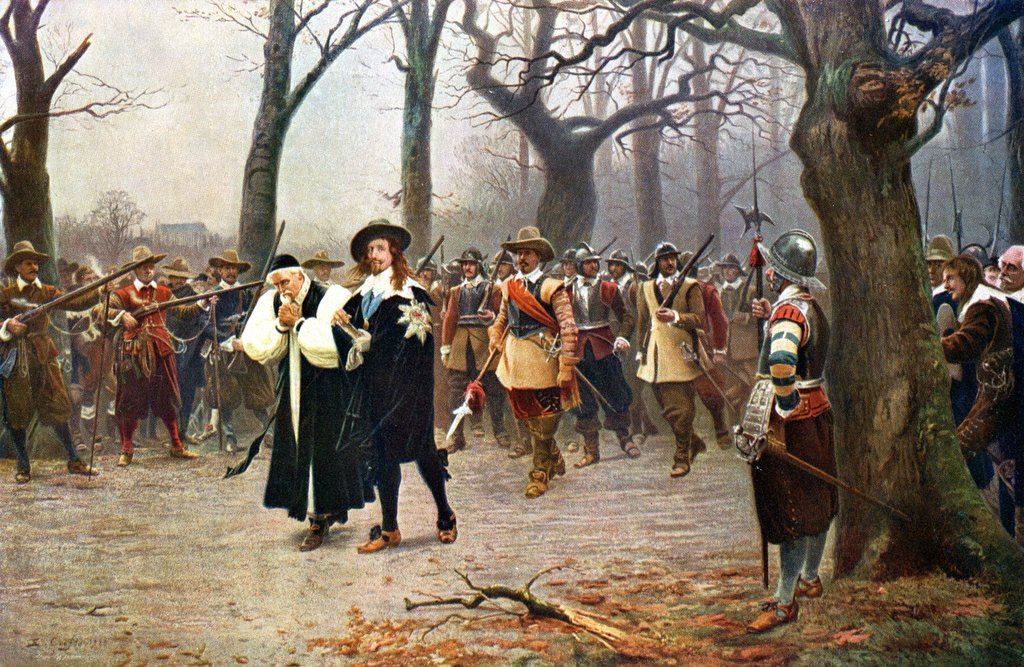
The second paper in the trio was given by Nicholas Smolenski on ‘Propagandistic Sensory Rhetoric of Charles I, 1647–49’. He opened by talking about the sensory landscape of Charles I’s execution, before turning to how the sensory rhetoric was manipulated by royalists in the face of parliamentarian attempts to break the link between the king and his subjects by supressing the sensory experiences. He then looked at the king’s posthumous reputation through its sensory rhetoric. I was fascinated when he noted that the king’s reported ability to heal scrofula also had resonances beyond healing the disease itself. As the swellings are most often around the eyes, by healing this disease he is also restoring their sight.

The final paper of the three was Samantha Bassler’s new research on ‘Feminine Voice, Sound, and Disability in Elizabeth Tanfield Cary’s The Tragedie of Mariam (1613) and Mary Sidney Herbert’s The Tragedie of Antonie (1592)’. Working on the premise that music, gender and disability constantly occur together in early modern English music. Music is often seen as healing, or as quite the opposite, and damaging, while women are particularly susceptible to its effects as well as madness. She wanted to look at less familiar texts than Shakespeare, and her focus on women writers is fairly new to musicology although it’s been looked at by literary scholars. Whilst I was already vaguely familiar with Mary Sidney Herbert, I’d never heard of Elizabeth Tanfield Cary – and what an amazing woman she sounds to have been! She certainly achieved her aim of piquing my interest in her.
 Home
Home 
Leave a reply to Glorious Sounds I | Jenni Hyde Cancel reply